What are you looking for?

Thursday, October 15, 2020

Top 10 Team:Long,Tai,Trung,Ha,Hanh,Minh.. IELTS Listening 1 - Section 2

 IELTS Listening 1 - Section 2

IELTS Listening 1 - Section 2

IELTS Tip

Don't worry about the parts of the test that are finished, or those yet to come. Concentrate fully on the module you have in front of you.

Sentence Completion TIP: Be careful that what you write fits grammatically with the other words in the sentence and is spelled correctly.


Click here to listen:

Questions 11-14

Complete the sentences below, using NO MORE THAN THREE WORDS for each answer.

11Dormouse numbers have fallen  as well as in the UK.

12Dormice are about as heavy as two .

13You are most likely to have seen a dormouse in a .

14In the UK, dormice probably live in hedges and woods, and next to .

Questions 15-17

Label the identification sheet below.

Write the correct letter A-E next to questions 5-8.

IELTS Listening Test

15opened by woodmice ..........

16opened by voles ..........

17opened by dormice ..........

Questions 18-20

Complete the summary below.

Using NO MORE THAN ONE WORD in each space.

If you find nuts opened by dormice 18  where you found them. Put them into some kind of 19  and 20  them (name and address). Post them to Action for Wildlife.

CHECK ANSWERS

 Audio Script

Presenter: Good morning, and welcome to our weekly programme about countryside matters. With me today I have Jacky Lamerton. Jacky works for the nature organization Action for Wildlife, and she's appealing for volunteers for a project she's organizing, so if you think you might be willing to help please listen carefully. Jacky ...

Lecturer: Thank you. Yes ... as you've just heard, I represent a charity called Action for Wildlife, which works to protect plants and animals. And I'm here today to talk about a project to save a type of mouse known as a dormouse. We can still find the dormouse in this area, but in the last few decades the number of dormice has seriously declined, not just in this country but across the world. There are several reasons for this - loss of habitat, climate change, competition for food - and this area of the UK is now regarded as one of the last strongholds. So naturally, we want to help the creature to survive here as much as we can.

The aim of the first stage of our project is simply to identify specific locations where dormice are still to be found, and estimate the number we have here. So I'll just tell you a little bit about the creature, in case you don't already know. The dormouse is a very attractive, very small mammal - it only weighs about the same as a couple of pound coins. It's bright golden in colour, and it has a thick furry tail and big black eyes. Now, you've probably all seen a picture of a dormouse, but you're very unlikely to have seen a real one because they're strictly nocturnal. Also, they hibernate from October to April, so it's not around at all for about half the year.

So where is the dormouse to be found? Well, dormice need to be near a variety of trees and plants, so they can be sure of a continuous supply of food throughout the spring and summer. They feed on flowers, pollen, fruit, insects, ripe nuts - things that are available in turn as the summer progresses. Here in the UK the dormouse is most likely to live in places like hedgerows, or woods, or at the edges of farmland.

So how do we find out exactly where dormice are? Well, as they're hard to spot, as I said, we have to use indirect methods. Instead of trying to see dormice themselves, we look for evidence of dormouse activity. Dormice eat hazelnuts, so we'll be looking for the shells that dormice have opened to get at the nut inside.

A lot of wildlife species eat hazelnuts - it's not just dormice. But it's usually possible to tell which particular animal has opened a nut by looking at the marks on the shells. So now, for those of you who would like to help us carry out this survey, let me tell you exactly what to do. You'll need to get an identification sheet like this from us, then you should spend time looking for hazelnut shells in the bottom of hedgerows, or on the ground in woodlands.

If you find one, use the identification sheet to try and establish what kind of creature has opened it. You'll see from the pictures on the sheet that different creatures do it in different ways. For example, you'll see that insects make a small hole in the shell, less than 2 millimetres across. Then there's another type of mouse called a woodmouse. Woodmice make a hole in the shell too, but they leave parallel tooth marks on the inner rim of the shell, as well as rough scratches on the surface. Thirdly there are little mammals called voles. These creatures don't leave any marks on the surface, but they leave tooth marks on the inner rim of the hole. And these marks are neat and parallel. So they're fairly easy to identify. Then there are squirrels and birds. They both open the nuts, leaving half shells that have got jagged edges. And finally we have our dormice. They make a hole in the shell that has a smooth inner edge. And the tooth marks it leaves are on the surface, at an angle to the hole. And these are the ones we're looking for of course.

Firstly, if you do find any nuts which you think have been opened by dormice you need to record their location as precisely as possible. You can use the grid references on a map, or you can sketch your own map, but if you do, be sure to include landmarks or road names. It's very important that we know exactly where the shells came from. Then put the nut shells in a small container. Any kind will do - a film box or a match box - anything that prevents them from being crushed in the post. And then finally, give them a label - just your name and contact details - and send them to Action for Wildlife. When we receive them an expert will look at the shells to confirm your identification. The address to send them to is ...


Top 10 Team:Long,Trung,Ha,Hanh,Minh...IELTS Listening 1 - Section 1


IELTS Listening 1 - Section 1

Listening Tip

In the IELTS Listening paper, Sections 1 and 3 are conversations between two or three people. Sections 2 and 4 are monologues with only one main speaker. Sometimes, you may hear another speaker introducing the talk or asking questions.

Related Topic: Listening Preparation

Click here to listen:
Questions 1-7Complete the form below, using NO MORE THAN THREE WORDS AND/OR A NUMBER for each answer.

Travel Safe

INSURANCE PLC
Department: Motor Insurance
Client details:
Name: Elisabeth 
Date of birth: 8.10.1975
Address:  (street) Callington (town)
Policy number: 
Accident details:
Date: 
Time: Approx. 
Supporting evidence: 
Medical problems (if any):  injuries

Listening Tip

In the IELTS Listening exam, you may be asked to label a map or plan. In such questions, think of ways you can describe where places are before you listen. You will need to think of vocabulary for directions, for example: on the left, first right, along the road and vocabulary for places or position, such as opposite, next to, behind, at the end of the street.

Questions 8-10

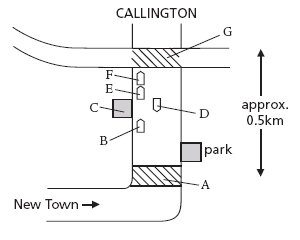
Label the diagram/plan below.

Write the correct letter, A-G, next to questions 8-10.

IELTS Listening Test

8traffic lights ..........

9petrol station ..........

10blue van ..........

CHECK ANSWERS

 Audio Script

Assistant 1:
Rawlings Insurance. Good morning. Can I help you?
Elisabeth:
Oh, hello. I'm ringing to report an accident.
Assistant 1:
A car accident?
Elisabeth:
Yes.
Assistant 1:
Just hold the line a moment please. I'm putting you through to our motor insurance department.
Assistant 2:
Hello?
Elisabeth:
Hello.
Assistant 2:
I understand you want to report an accident?
Elisabeth:
Yes. My car's been damaged - someone came out in front of me ...
Assistant 2:
Could I just check a few personal details before we go any further?
Assistant:
Oh yes, sorry.
Assistant 2:
Your name, first of all.
Elisabeth:
It's ELISABETH Ricard.
Assistant 2:
Is that R-I-K-A-R-D?
Elisabeth:
It's spelt with a C not a K.
Assistant 2:
Oh, OK ... And your date of birth please?
Elisabeth:
It's the eighth of October, 1975.
Assistant 2:
... And lastly, I just need to check your address.
Elisabeth:
Oh, actually I moved house last month so the street name's different. It's 60 Forest Road. I think you've got 22 Ash Avenue on your records?
Assistant 2:
I have. So, I'll just make a note of that ... That's fine ... And is that in the same town still? Callington?
Elisabeth:
That's right.
Assistant 2:
Right, now ... do you have your insurance policy in front of you?
Elisabeth:
Yes, I do.
Assistant 2:
Can you give me the policy number please? It's at the top.
Elisabeth:
Oh yes. Five-oh-nine-two-four?
Assistant 2:
It's in a box - it should start with letters ...
Elisabeth:
Oh, C-Z- double eight-oh-nine?
Assistant 2:
That's the one. And now I want to ask you about the accident itself. Is that OK?
Elisabeth:
Yes, that's fine.
Assistant 2:
First of all, did it happen today?
Elisabeth:
No, it happened yesterday evening, but by the time I got home it was late, so I didn't call.
Assistant 2:
That's not a problem. So ... let's see ... today's the thirteenth of September, so it happened on the twelfth. Is that right?
Elisabeth:
It is.
Assistant 2:
Do you know approximately what time the accident occurred?
Elisabeth:
Er ... oh dear ... I wasn't wearing a watch, and I was a bit shocked. But I'd say it was between 8.15 and 8.45.
Assistant 2:
That's OK. I'll just record that it happened at about 8.30. It doesn't matter exactly ... And I don't suppose you've got any supporting evidence have you? I mean witness statements, that kind of thing?
Elisabeth:
I don't have witness statements I'm afraid, but I've got a police report. They came and measured up and checked the marks on the road. But unfortunately nobody else was around at the time of the accident.
Assistant 2:
Any hospital report?
Elisabeth:
No.
Assistant 2:
So I take it you don't have any medical problems then? Any injuries?
Elisabeth:
Only minor ones. It was mainly the car that got damaged luckily.
Assistant 2:
Absolutely. But we do recommend that you have a check up anyway. Within twenty-four hours if possible.
Elisabeth:
Yes, OK. I'll make an appointment today.
Assistant 2:
Fine. And now, can you tell me what happened exactly? I'm going to make a few notes.
Elisabeth:
I was driving home from the swimming pool and ...
Assistant 2:
I don't know Callington at all, so could you describe it for me? Where did the accident happen?
Elisabeth:
On the road between New Town and Callington. I was driving from New Town, heading towards Callington, and ...
Assistant 2:
OK, just let me draw the road layout ... Right. OK?
Elisabeth:
When you leave New Town there's a sharp bend in the road and then there's a railway bridge.
Assistant 2:
OK.
Elisabeth:
And then about half a kilometre further on there's a crossroads with traffic lights. And I was just in between the two when it happened. I wasn't going very fast, in fact I definitely ...
Assistant 2:
So you'd already gone over the bridge?
Elisabeth:
Yes. And I'd passed the park - that's on the right hand side. And I was just approaching the petrol station ...
Assistant 2:
Where's that then?
Elisabeth:
It's a bit further along, on the opposite side.
Assistant 2:
So, on your near side then?
Elisabeth:
Yes. As I was approaching it I saw a blue van coming towards me. The driver had stopped in the middle of the road.
Assistant 2:
Was he indicating?
Elisabeth:
Yes. He was waiting to turn into the petrol station. But then at the last minute he decided to turn right in front of me. He must have thought he had enough time, but I had to swerve to avoid him. And I came off the road and landed in a ditch on the opposite side.
Assistant 2:
Mmm. I don't suppose he stopped did he?
Elisabeth:
Oh yes. He came over to see if I was OK, but he tried to say it was my fault. And there wasn't ...
==========================================================
Nếu còn gì thắc mắc thì hãy  Post a Comment  hoặc dùng Contact Form dưới đây  . Chúc các bạn học tập tốt nhé!
Chúc mừng top 10 bạn đã có bài làm tốt nhất tuần &được nhận qùa tặng của nhà tài trợ!
“I’m helping you unlock your potential” MT


Tuesday, October 13, 2020

IELTS Speaking Preparation


The Speaking Module consists of a face-to-face interview with an examiner. The examiner will lead the candidate through the three parts of the test: an introduction and interview, an individual long turn where the candidate speaks for one to two minutes on a particular topic, and a two-way discussion thematically linked to the individual long turn. This interview will last for approximately 11-14 minutes. The examiner records the interview.

Part 1

Part 1 lasts for 4 to 5 minutes and begins with introduction. The examiner then asks a number of questions about familiar topics such as your studies, work, hobbies, interests, etc.

Part 2

Part 2 lasts 3 to 4 minutes and is based on the candidate giving a short talk. You are giving a card with a familiar topic and several prompts. You then have one minute to make notes on what you want to say before speaking for two minutes on the topic given. You do not have a choice of topic but the topics are based on your own experience, such as a person or place you know, or an event or activity you have experienced. The examiner may ask you a brief question at the end.

Part 3

Part 3 lasts for 4 to 5 minutes. The questions in Part 3 will be connected to the topic of Part 2. They allow you to discuss more abstract issues and ideas. Part 3 is a discussion between you and the examiner.

You are expected to be able to respond to questions on familiar and unfamiliar topics and to speak at length. You are assessed on a nine-band scale for fluency, vocabulary, grammar and pronunciation.

IELTS Speaking Tips

Your choice of grammar shows how you feel about your occupation.

Present simple

I work for a company which makes car engine parts.
This implies you feel the job is long term.

Present continuous

I'm working for a company which makes car engine parts.
This implies you feel the job is temporary.

If you're a student, it's common to use the present continuous to describe your course:
I'm doing a Master's degree in Forest Management.

Don't just say I'm a student or I work in a restaurant. Give more details in your answer. For example:

  • I'm a third-year student studying Law at the local university.
  • I'm working as a waiter in a pizza restaurant in the main square of this town. You may have seen it. It's called Pizza Hut.

The examiner may ask for your opinion or feelings about your occupation. It can be a good strategy to contrast a positive and a negative opinion. For example:

  • It's not an easy subject. There's a lot of reading, and the exams are very difficult, but it'll be worth it.
  • I'll be able to get a good job when I graduate, and the career prospects for lawyers are excellent.
  • It's hard work and - I have to be honest - the pay isn't great, but it can be a lot of fun, especially when the restaurant is busy. I work with some really nice people.
  • ================================================================
  • Part 1


    Answer the questions:

    1Do you work or are you a student?

    Model answer:

    2Do you have a large family?

    Model answer:

    3Describe your hometown.

    Model answer:

    4What's the weather like in your country?

    Model answer:

    5What are some of your hobbies?

    Model answer:

    Part 2


    You will have to talk about the topic for one to two minutes.
    You have one minute to think about what you’re going to say.
    You can make some notes to help you if you wish.

    Describe a person who helped you.

    You should say:

    • where you met the person
    • what relationship this person was to you
    • what was special about them

    And explain how this person helped you.

    Would you like to help someone in this way?

    Model answer:

    Part 3


    Answer these questions:

    1Do you think we can learn anything from older generations?

    Model answer:

    2Compare the role of the family in today's world to the past.

    Model answer:

    3Should we ask our family for help, or should we try being independent?

    Model answer:

    4In your opinion, when does a child become an adult?

    Model answer: